
1 min
我或者朋友们复现不出来的论文集合,长期更新
培养判断力,节约 Context
免责声明#
复现不出来不等于学术造假,也有我们水平不够的原因。
2026年6月#
MemoryVLA: Perceptual-Cognitive Memory in Vision-Language-Action Models for Robotic ManipulationTemporal context is essential for robotic manipulation because such tasks are inherently non-Markovian, yet mainstream VLA models typically overlook it and struggle with long-horizon, temporally dependent tasks. Cognitive science suggests that humans rely on working memory to buffer short-lived representations for immediate control, while the hippocampal system preserves verbatim episodic details and semantic gist of past experience for long-term memory. Inspired by these mechanisms, we propose MemoryVLA, a Cognition-Memory-Action framework for long-horizon robotic manipulation. A pretrained VLM encodes the observation into perceptual and cognitive tokens that form working memory, while a Perceptual-Cognitive Memory Bank stores low-level details and high-level semantics consolidated from it. Working memory retrieves decision-relevant entries from the bank, adaptively fuses them with current tokens, and updates the bank by merging redundancies. Using these tokens, a memory-conditioned diffusion action expert yields temporally aware action sequences. We evaluate MemoryVLA on 150+ simulation and real-world tasks across three robots. On SimplerEnv-Bridge, Fractal, LIBERO-5 suites and Mikasa-Robo, it achieves 71.9%, 72.7%, 96.5%, and 41.2% success rates, respectively, all outperforming state-of-the-art baselines CogACT and pi-0, with a notable +14.6 gain on Bridge and +11.8 gain on Mikasa-Robo. On 12 real-world tasks spanning general skills and long-horizon temporal dependencies, MemoryVLA achieves 84.0% success rate, with long-horizon tasks showing a +26 improvement over state-of-the-art baseline. Project Page: this https URL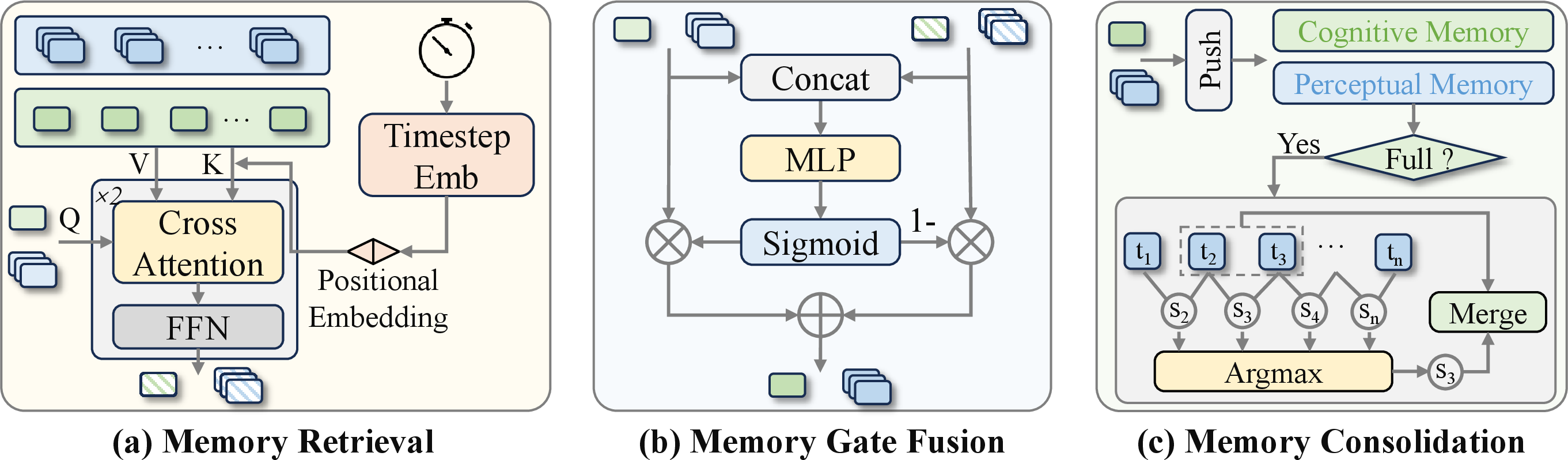
在 rebuttal 阶段被审稿人要求复现,然而几位学长轮番复现都达不到论文中 chaim 的效果。最终无奈给 AC 写小作文。
Fast-WAM: Do World Action Models Need Test-time Future Imagination?World Action Models (WAMs) have emerged as a promising alternative to Vision-Language-Action (VLA) models for embodied control because they explicitly model how visual observations may evolve under action. Most existing WAMs follow an imagine-then-execute paradigm, incurring substantial test-time latency from iterative video denoising, yet it remains unclear whether explicit future imagination is actually necessary for strong action performance. In this paper, we ask whether WAMs need explicit future imagination at test time, or whether their benefit comes primarily from video modeling during training. We disentangle the role of video modeling during training from explicit future generation during inference by proposing \textbf{Fast-WAM}, a WAM architecture that retains video co-training during training but skips future prediction at test time. We further instantiate several Fast-WAM variants to enable a controlled comparison of these two factors. Across these variants, we find that Fast-WAM remains competitive with imagine-then-execute variants, while removing video co-training causes a much larger performance drop. Empirically, Fast-WAM achieves competitive results with state-of-the-art methods both on simulation benchmarks (LIBERO and RoboTwin) and real-world tasks, without embodied pretraining. It runs in real time with 190ms latency, over 4$\times$ faster than existing imagine-then-execute WAMs. These results suggest that the main value of video prediction in WAMs may lie in improving world representations during training rather than generating future observations at test time. Project page: this https URL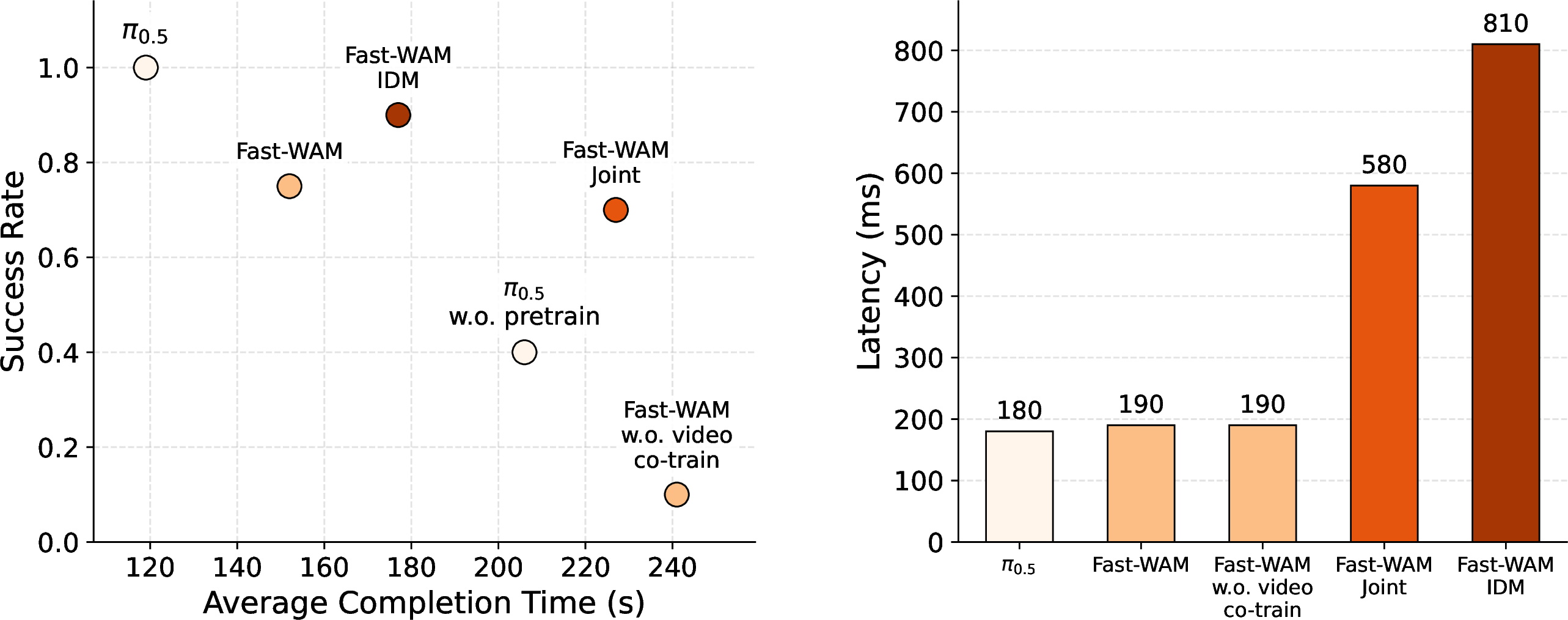
群友反映 FastWAM 复现不出来。在 robotwin 比论文 chaim 的低了 10%。
2026年11月#
Agentic World Action ModelsRecent world action models provide visual foresight and future prediction for robot manipulation, but lack explicit mechanisms for compositional skill reuse. Agentic robotics combines code-based planning and reasoning with reusable skills, but often lacks predictive grounding in physical dynamics. We introduce AW-0, an agentic world action model framework that integrates code-based planning with joint video and action prediction. We jointly model code, future video, and robot actions as three coupled generative streams within a unified mixture-of-transformers architecture. Within this architecture a code expert generates parameterized skill routines and control logic while video and action experts generate future visual states and low-level motor commands. Code serves two complementary roles: it structures multi-step prediction and control within the world model and represents skills as reusable programs for subsequent agentic execution. We further introduce an automated curation pipeline that labels robot and human video trajectories with aligned programs and consolidates recurring routines into reusable skill libraries. Evaluations on RoboTwin 2.0 and physical bimanual manipulation tasks show improved task performance over VLA and WAM baselines, alongside gains in language following, semantic reasoning and robustness, demonstrating that agentic code enables connection between planning, prediction and execution within WAMs.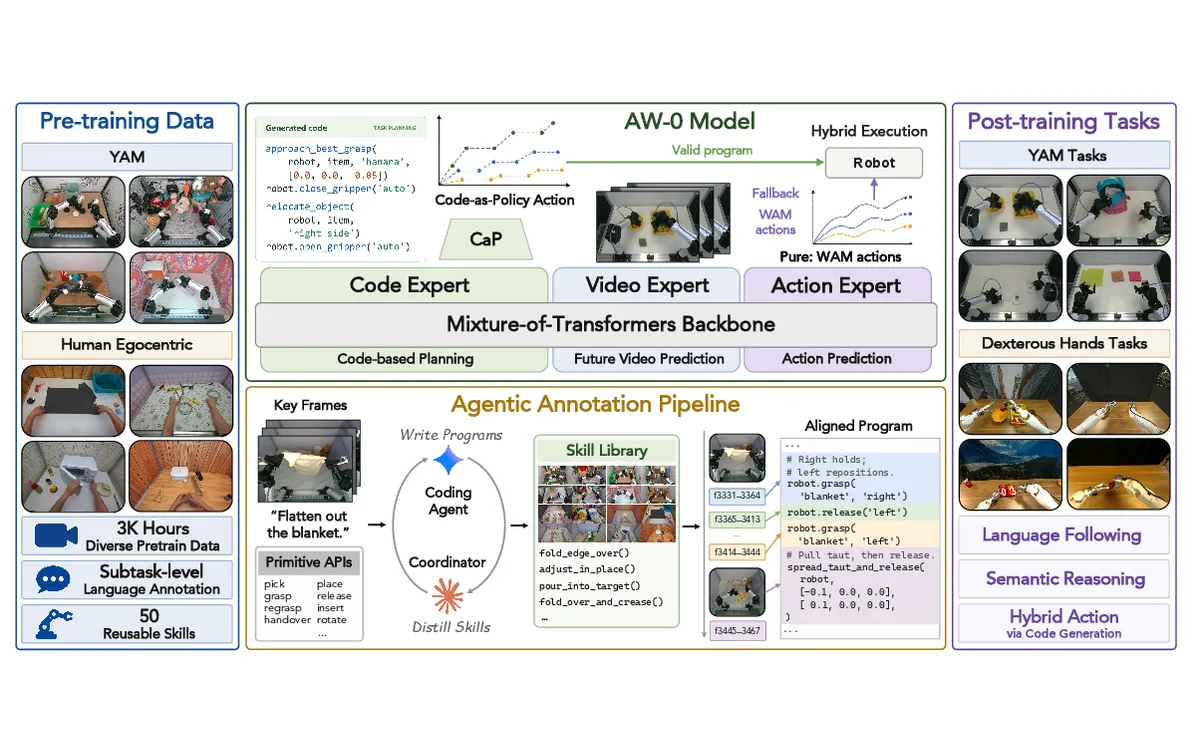
使用一个 2b 的 LLaDA 生成 code 作为 subtasks 辅助 WAM 完成任务。
使用我之前探索 agentic VLA 的私有 LIBERO detailed captain 数据进行长达两日的训练。把 detailed captain 从语言换成不可执行的 Python code 实际上效果并没有提升。并且 LLaDA 的 python code 只起到语义的作用,这个和 detailed captain 有什么区别呢?